
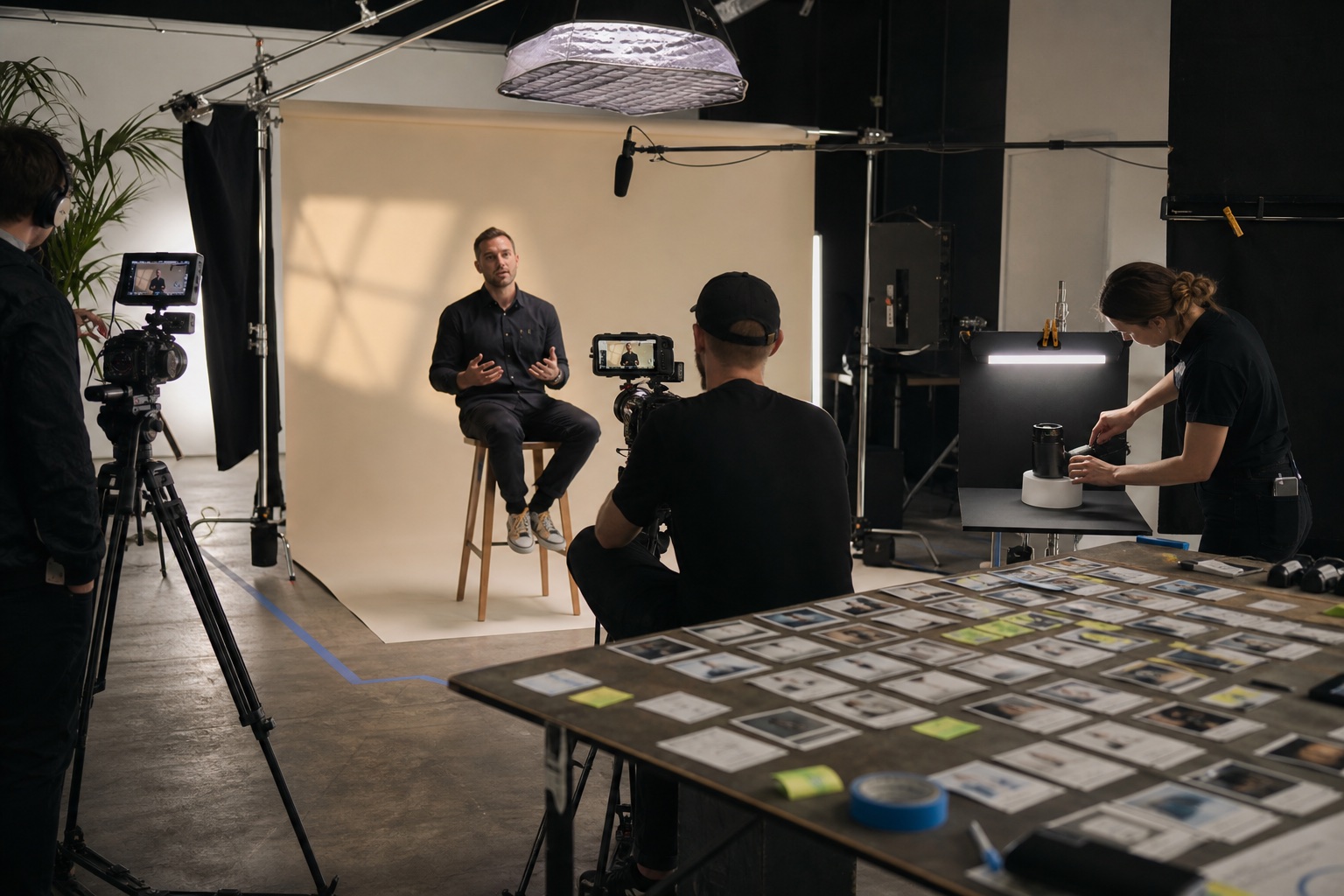
Plan by content pillar, not platform
Choose three or four subjects the audience consistently needs help with. For each subject, prepare a main explanation, a demonstration, a common mistake and a concise answer to one recurring question.
This creates a coherent library that can later be translated for different channels without forcing every recording into the same format.
Build modular setups
Group recordings by location, lighting and energy. Capture all pieces that use one setup before changing the room. Small wardrobe or framing changes can create variation without rebuilding production from zero.
- A direct-to-camera setup for clear explanations.
- A demonstration setup for process and proof.
- A looser conversational setup for stories and opinions.
- A short block for stills, details and silent supporting footage.
Protect the highest-value work first
Film the essential pieces while energy and time are strongest. Treat bonus concepts as optional rather than allowing them to weaken the core library.
At the end of each setup, capture clean openings and endings in several lengths. These small variations give editors far more flexibility than another pile of disconnected footage.
Design the day as modules
A monthly filming day can be organised around three audience questions instead of twelve platform deliverables. For each question, capture a clear opening, the complete explanation, one practical example, an objection and a concise conclusion. Add the product, process or environmental evidence that makes the answer visible.
Those modules can support several useful edits because each has internal logic. The team avoids the common trap of cutting one long conversation into fragments that begin without context and end before the viewer receives a complete idea.
Put the idea into the room.
Treat the shoot as the creation of a reusable source library, not a race to collect clips. Each recording should have a clear premise, beginning, useful proof and ending. A smaller library of complete ideas gives an editor more value than hours of fragments that depend on captions to become meaningful.
Check the decision before adding output.
- Is each recording module built around one audience question?
- Can every planned short version deliver a complete useful point?
- Are openings and conclusions being recorded deliberately rather than invented in the edit?
- Does the shot plan capture evidence as well as talking-head explanation?
Quick answers
Questions people ask about this topic.
How do you batch a month of video content in one day?
Organise the day around a few audience questions and repeatable setups. For each question, record a complete explanation, proof, a concise version, an objection and a clean ending before moving to optional variations, stills and supporting footage.
How many videos should you record in one filming day?
There is no universal number. Plan for the number of complete, useful ideas the speaker and crew can execute without weakening clarity or energy. Six well-supported source modules can create more valuable edits than twenty fragments that lack context, evidence or endings.
Sources & further reading
Evidence you can inspect.
These references support the research-dependent parts of this field note. The practical recommendations and working frameworks remain editorial analysis.
- 01The Story Behind #OverheardAtCoSchedule Wistia Customer Showcase
A production case documenting multi-episode filming sprints and advance planning.
- 02State of Video Report 2025 Wistia
Primary survey and platform research across more than 100 million hosted videos.
A practical next pass.
- 01Choose three audience problems that are specific enough to answer in a single recording.
- 02Prepare an explanation, demonstration, common mistake and concise answer for each problem.
- 03Schedule complete hero explanations first, then variations, stills and silent supporting footage.
- 04Log the strongest takes and intended formats before the production team leaves the room.